If you own or manage a low-slope or flat-roof property in Miami-Dade, Broward, Palm Beach, or Monroe County, the roof has to handle more than normal wear. That is why many property owners compare SBS modified bitumen roofing with other low-slope systems before repair or replacement. South Florida heat, UV exposure, ponding water, salt air, and hurricane-season wind-driven rain can all stress a flat roofing system. SBS modified bitumen roofing is a common option for low-slope roofs because it combines asphalt waterproofing with rubber-like flexibility. But like any roof system, its performance depends on the deck condition, installation method, drainage, flashing details, and ongoing maintenance.
What Is SBS Modified Bitumen Roofing?
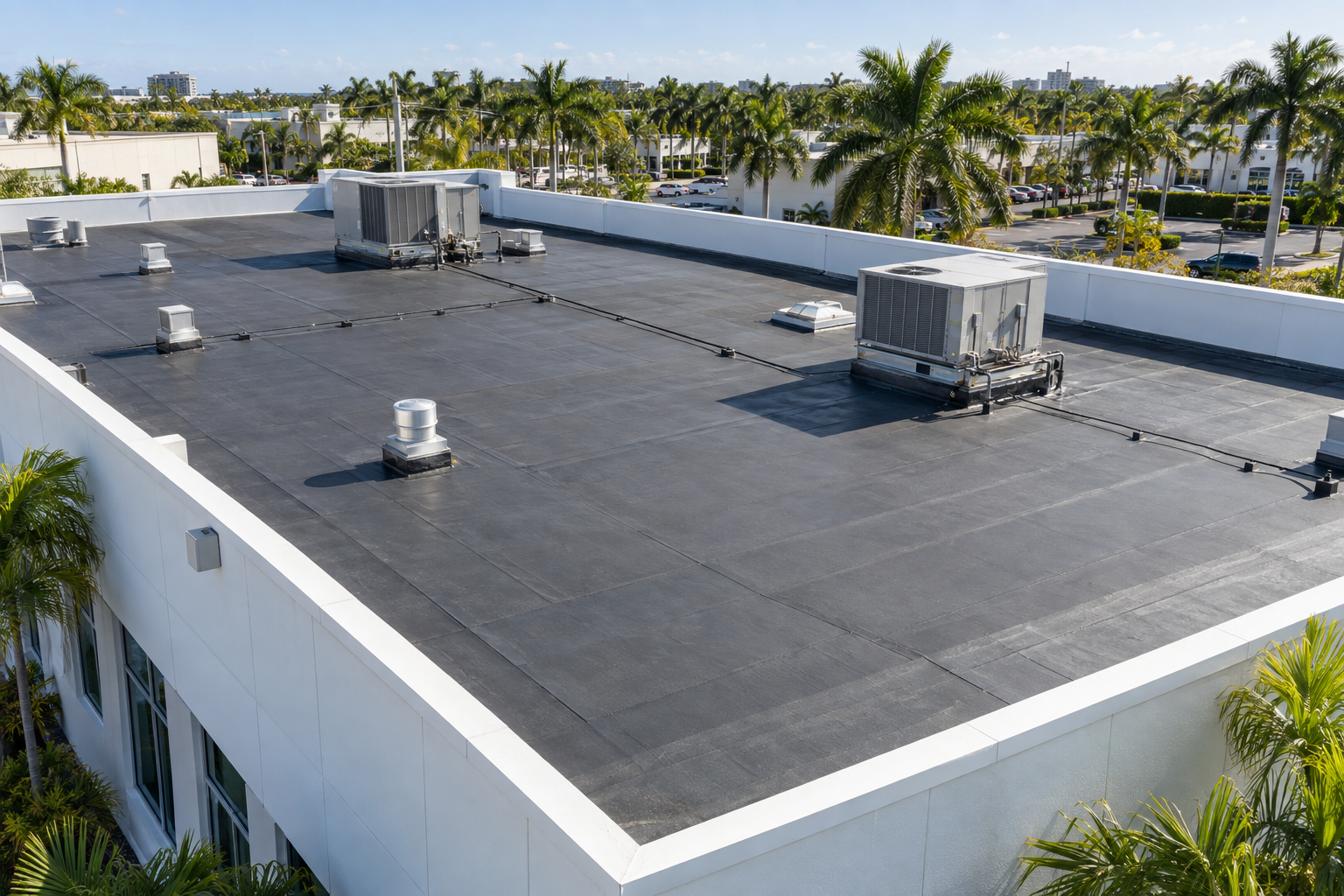
SBS modified bitumen roofing is an asphalt-based membrane roofing system made for low-slope roof areas. “SBS” stands for styrene-butadiene-styrene, a rubber-like polymer added to asphalt to improve flexibility and weather resistance. Modified bitumen is asphalt roofing reinforced and enhanced with polymer modifiers. Modified bitumen membranes are commonly used on low-slope roofs, which the roofing industry generally defines as roofs with a slope of 3:12 or less. [1]
A typical SBS system may include:
- A prepared roof deck or approved existing substrate
- Insulation or cover board when required
- A base sheet or ply sheet
- An SBS-modified cap sheet
- Flashings around parapets, drains, curbs, vents, and penetrations
- Surfacing, such as mineral granules or coating depending on the system
Think of it as a layered waterproofing system. The membrane does the main water-shedding work, but the details at edges, seams, drains, and penetrations often determine how well the roof performs over time. A cap sheet is the top membrane layer that provides weather exposure protection.
Why SBS Makes Sense for Florida Low-Slope Roofs
South Florida flat roofs take a beating from sun and moisture. SBS modified bitumen roofing is valued because it remains more flexible than traditional asphalt roofing, which can help the membrane move with normal expansion and contraction.
For many South Florida buildings, SBS modified bitumen roofing offers a practical balance of waterproofing, flexibility, and repairability. For Florida properties, the biggest advantages are practical:
- Flexibility: SBS-modified asphalt can better tolerate thermal movement.
- Multi-layer protection: Many systems use base and cap sheets for redundancy.
- Granule surfacing options: Mineral-surfaced cap sheets can add UV protection.
- Repairability: Localized issues may be repairable when the surrounding roof is still in serviceable condition.
- Compatibility with many low-slope properties: SBS is often used on commercial roofs, multifamily buildings, additions, garages, and flat roof sections on residential properties.
That said, SBS is not a cure-all. If the roof has poor drainage, saturated insulation, a soft deck, failing parapet flashing, or repeated ponding water, those issues need to be addressed as part of the roofing plan.
For larger properties, it can help to compare options with a contractor who regularly handles commercial flat roof services in South Florida.
When Is SBS Modified Bitumen Roofing the Right Choice?
SBS is often a strong fit when a building needs a durable low-slope roof assembly with layered waterproofing, flexible asphalt performance, and serviceable repair options. It may be especially useful for properties with parapet walls, roof-mounted equipment, pedestrian maintenance access, or complex flashing areas.
SBS may be a good fit when:
- The roof has many penetrations, curbs, drains, or flashing transitions.
- The property needs a multi-ply or layered waterproofing approach.
- The owner wants a system that can be inspected and repaired in localized areas.
- The roof assembly can be installed to meet the applicable Florida Building Code and product approval requirements.
- Drainage can be corrected or maintained so water does not sit on the roof.
SBS may not be the best fit if the roof has unresolved structural issues, chronic ponding, saturated insulation, unsafe access, or a deck that is not suitable for the selected assembly. Flat roof performance depends on the full assembly, not the membrane material alone.
SBS vs. APP Modified Bitumen
SBS and APP are both modified bitumen roofing materials, but they use different polymer modifiers. SBS uses styrene-butadiene-styrene, which gives the asphalt a rubber-like flexibility. APP modified bitumen uses atactic polypropylene, a plastic-like modifier that is often associated with torch-applied applications.
The better option depends on the roof design, approved assembly, installation method, project conditions, and manufacturer requirements. In South Florida, the choice should also consider wind-uplift requirements, heat exposure, drainage, and whether the system has the right approvals for the building’s location.
How SBS Modified Bitumen Roofs Are Installed
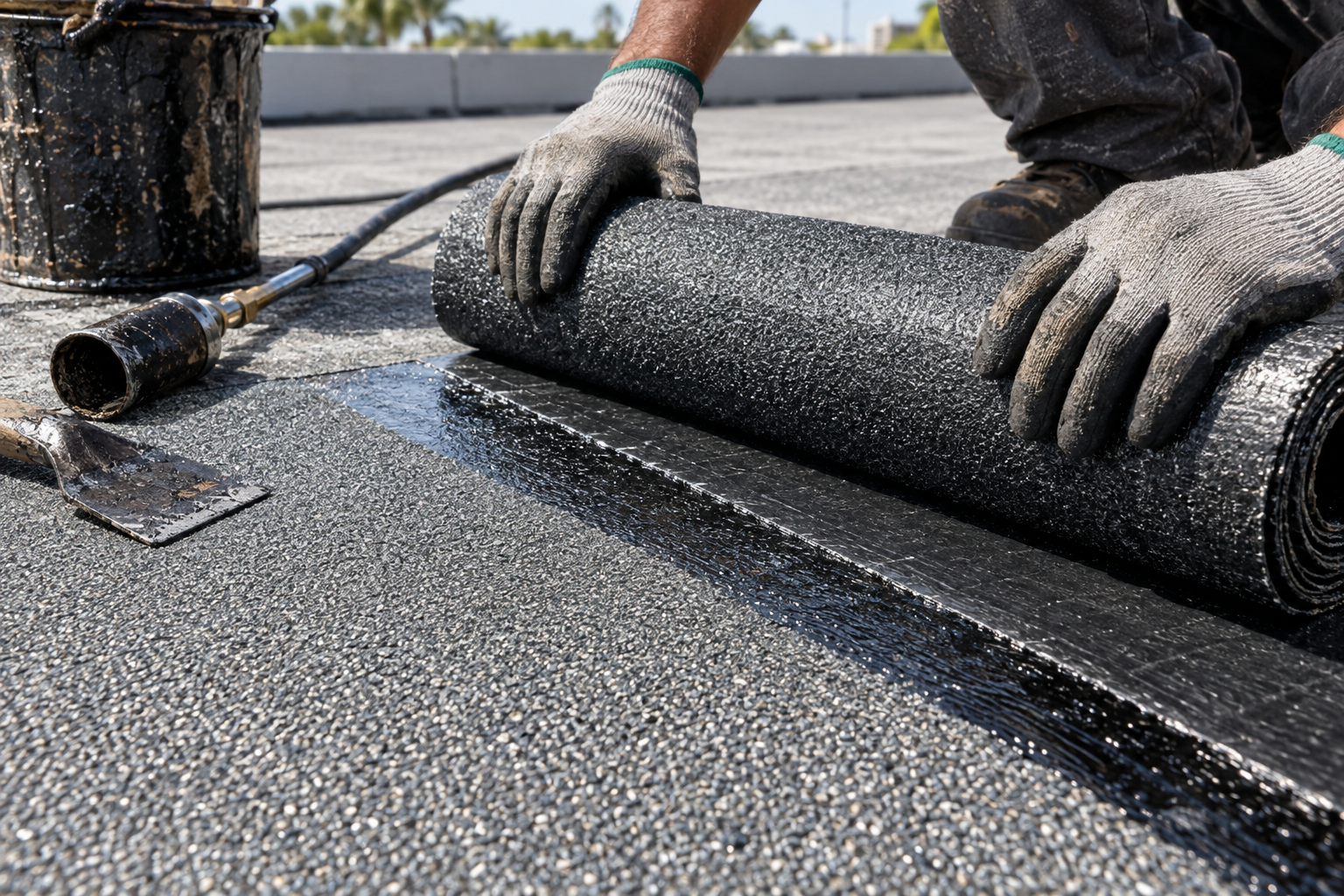
SBS modified bitumen roofing systems can be installed several ways depending on the product, building, code requirements, and manufacturer specifications. Common methods include torch-applied, cold-applied adhesive, hot asphalt, self-adhered membranes, or mechanically attached components.
Torch-Applied vs. Self-Adhered vs. Cold-Applied SBS Systems
Each installation method has tradeoffs. Torch-applied systems use heat to bond the membrane and require strict fire-safety procedures. Cold-applied systems use approved adhesives and may be selected when open flame is not ideal. Self-adhered membranes use factory-applied adhesive backing and can reduce certain jobsite application risks when installed correctly. Hot asphalt and mechanically attached components may also be part of approved assemblies depending on the roof design.
The right installation method should come from the tested assembly, the manufacturer’s instructions, the deck or substrate condition, and the building’s code requirements—not preference alone.
In South Florida, installation planning also has to account for wind resistance and building-code requirements. Roof assemblies must be selected and installed according to applicable approvals, design pressures, and Florida Building Code requirements for the property location. [2]
Important installation details include:
- Deck preparation: The substrate must be clean, dry, and suitable.
- Slope and drainage: Water should move toward drains, scuppers, or gutters.
- Seam quality: Laps must be properly bonded and checked.
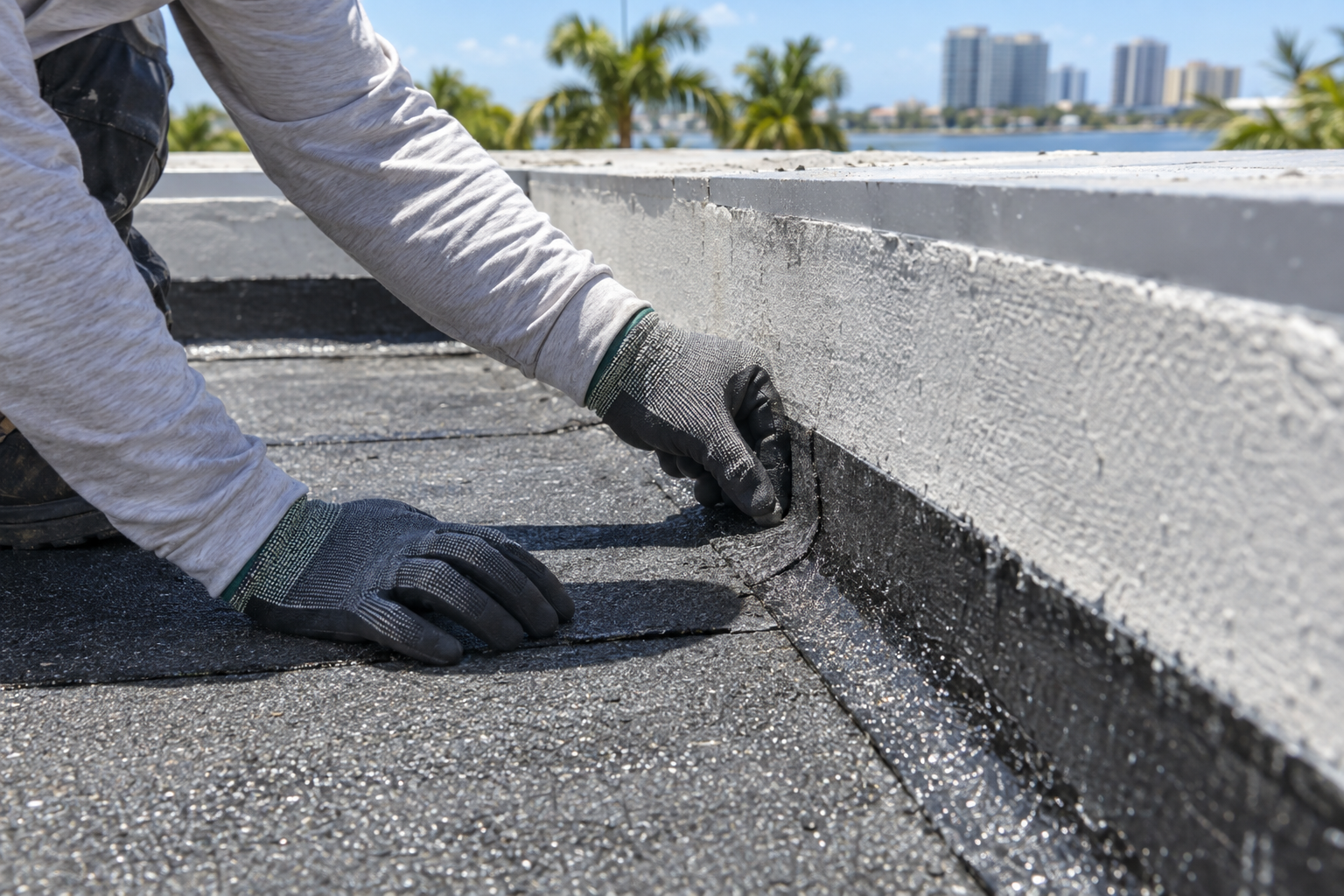
- Flashing transitions: Parapets, walls, HVAC curbs, and pipe penetrations need careful detailing.
- Edge metal: Perimeter details matter because wind uplift often starts at edges and corners.
- Manufacturer requirements: Warranties typically depend on approved materials and correct installation.
In Miami-Dade and nearby coastal areas, roof-system selection should not be based on material type alone. The tested assembly, attachment method, perimeter conditions, and project-specific requirements all matter. In the High-Velocity Hurricane Zone, many roofing products and assemblies must be checked against applicable approvals, including Miami-Dade County Product Control Notices of Acceptance where required. [3]
What Can Go Wrong on a Flat Roof?
Many modified bitumen problems are easy to miss from the ground. A roof may look “fine” from the parking lot while seams, drains, or flashing are already aging.
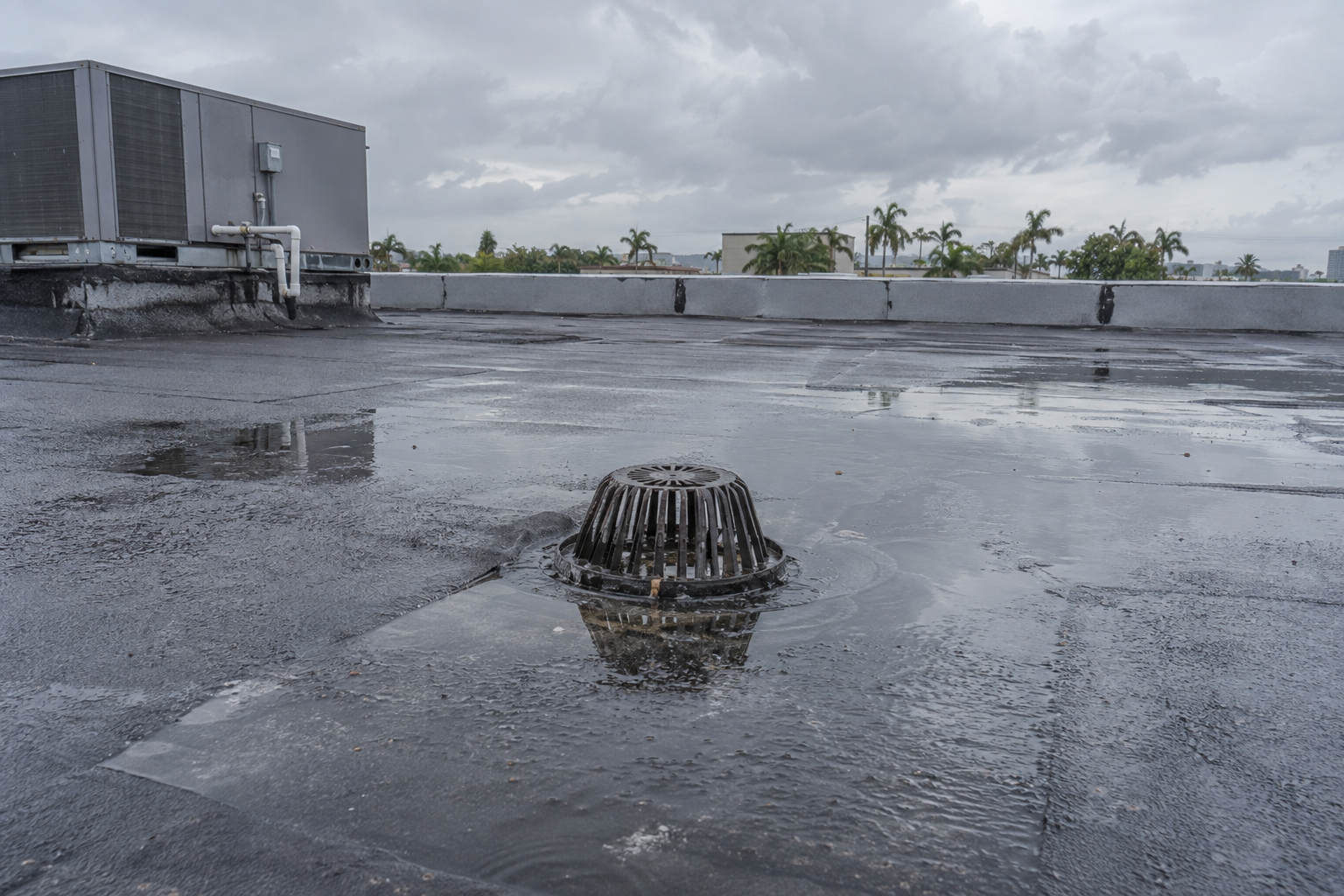
The most common SBS modified bitumen roofing issues usually appear at seams, drains, edges, and flashing transitions. Common warning signs include:
- Ponding water that remains long after rainfall
- Open seams or fishmouths at membrane laps
- Blisters, ridges, or soft areas underfoot
- Cracked or missing surfacing granules
- Deteriorated flashing at parapet walls
- Rusted or loose edge metal
- Staining on interior ceilings
- Repeated leaks around HVAC curbs or drains
Ponding water is especially important on low-slope roofs because standing water can speed up membrane aging and expose weak points around seams and penetrations. Ponding water is standing water that remains on the roof after rainfall instead of draining away. A fishmouth is an open wrinkle or gap at a membrane lap that can allow water intrusion. The International Building Code requires roof drainage systems to be designed to prevent accumulation of rainwater, and overflow drainage is required where water could be trapped by roof edges. [4]
If you already see staining, active leaks, or soft areas, it is time to schedule flat roof leak repair before the damage spreads.
SBS vs. TPO: Which Is Better?
SBS modified bitumen and TPO are both used on low-slope roofs, but they are different systems.
SBS is asphalt-based and often installed in multiple plies. It is known for durability, flexibility, and repairability. TPO is a single-ply thermoplastic membrane that is heat-welded at seams and commonly comes in reflective white sheets.
Choosing between TPO and SBS modified bitumen roofing should start with the building’s drainage, deck condition, and code requirements. The right choice depends on:
- Roof size and layout
- Existing roof type
- Drainage conditions
- Foot traffic
- HVAC equipment density
- Budget
- Building-code and approval requirements
- Desired reflectivity
- Maintenance expectations
| Factor | SBS Modified Bitumen | TPO | |—|—|—| | Material type | Asphalt-based modified membrane | Single-ply thermoplastic membrane | | Typical seam method | Bonded laps depending on system type | Heat-welded seams | | Common strength | Layered waterproofing and repairability | Reflectivity and large-sheet coverage | | Detail work | Often strong around complex flashing when installed well | Requires precise heat welding and detailing | | Best evaluated by | Full assembly, drainage, substrate, and approvals | Full assembly, drainage, substrate, and approvals |
For example, a roof with many penetrations and complex flashing areas may lead to a different recommendation than a large open warehouse roof. A professional inspection helps identify which system fits the building instead of forcing one material into every situation.
Repair or Replace an SBS Modified Bitumen Roof?
Not every leak means the roof needs replacement. Localized seam openings, punctures, small flashing defects, or isolated damage may be repairable when the surrounding roof remains dry, bonded, and serviceable. A low-slope roof inspection can help determine whether the issue is isolated or part of a larger system failure.
Replacement becomes more likely when there is widespread membrane deterioration, repeated leaks, saturated insulation, chronic ponding water, extensive blistering, or a deck problem that cannot be corrected with a surface repair. A roof that has been patched many times in the same area may also need a broader repair plan or full replacement.
For residential properties with additions, garages, or modern flat roof sections, the decision may involve both waterproofing and how the low-slope area ties into the rest of the home. If the assembly is near the end of its useful life, planning a flat residential roof replacement can be more cost-effective than chasing repeated leaks.
Maintenance Tips for SBS Modified Bitumen Roofing
SBS roofs still need routine care. In South Florida, it is smart to inspect flat roofs before hurricane season and after major wind or rain events. The Atlantic hurricane season runs from June 1 through November 30. [5]
Basic maintenance includes:
- Keep drains, scuppers, and gutters clear.
- Remove debris that can trap moisture.
- Check seams, flashings, and edge metal.
- Look for membrane punctures after rooftop service work.
- Document roof condition with dated photos.
- Schedule repairs before small issues spread.
Avoid walking the roof unnecessarily. If access is needed, use proper safety procedures and avoid stepping on soft, blistered, or wet areas.
After major wind or rain events, property owners should also look for loose edge metal, displaced rooftop components, blocked drainage, or new interior staining. If storm conditions expose a roof weakness, hurricane-season roof damage repairs should be handled quickly and safely.
FAQ: SBS Modified Bitumen Roofing in South Florida
What is SBS modified bitumen roofing?
SBS modified bitumen roofing is a low-slope roof membrane system made from asphalt modified with styrene-butadiene-styrene polymer, which helps improve flexibility and weather resistance.
Is SBS modified bitumen roofing good for South Florida?
Yes, SBS modified bitumen roofing can be a strong option for South Florida low-slope roofs when the deck, drainage, flashing, wind-uplift requirements, and installation method are properly addressed.
How is SBS modified bitumen roofing installed?
SBS modified bitumen roofing may be torch-applied, cold-applied, hot-asphalt-applied, self-adhered, or mechanically attached depending on the product, building, code requirements, and manufacturer specifications.
What causes SBS modified bitumen roof leaks?
Common leak sources include open seams, failed flashing, clogged drains, ponding water, punctures, deteriorated edge metal, and problems around HVAC curbs or roof penetrations.
Can SBS modified bitumen roofing be repaired?
Yes, localized SBS roof damage can often be repaired if the surrounding membrane, insulation, deck, and drainage are still in serviceable condition.
How long does an SBS modified bitumen roof last?
Service life depends on installation quality, drainage, maintenance, exposure, and roof traffic. A well-installed and maintained modified bitumen roof can provide many years of service, but South Florida UV, heat, and storms make regular inspections important.
Is SBS modified bitumen good for flat residential roofs?
Yes, it can be a strong option for flat or low-slope residential roof sections, including additions, garages, and certain modern roof designs. The roof slope, drainage, deck condition, and code requirements should be reviewed before choosing the system.
Can SBS roofing handle hurricane-season rain?
SBS systems are designed for low-slope waterproofing, but hurricane-season performance depends on the complete roof assembly, seams, flashing, drainage, and perimeter attachment. No flat roof should be judged by membrane type alone.
Can a modified bitumen roof be repaired instead of replaced?
Sometimes. Localized seam issues, punctures, or flashing problems may be repairable if the roof is otherwise sound. Widespread deterioration, saturated insulation, repeated leaks, or major drainage issues may point toward replacement.
What should I ask during a flat-roof inspection?
Ask about membrane condition, seam integrity, drainage, flashing, roof penetrations, edge metal, soft areas, and whether the roof assembly appears suitable for the building’s current use and exposure.
Closing CTA
Duke Contractors provides professional roofing inspections, estimates, repairs, and flat-roof replacement services across Miami-Dade, Broward, Palm Beach, Monroe County, and South Florida. If your low-slope roof is aging, leaking, ponding water, or due for a pre-season review, schedule a free consultation with a licensed South Florida roofing contractor and get clear next steps for your SBS modified bitumen roofing system.
Whether you need to schedule a flat-roof inspection, request a repair estimate, or plan a low-slope roof replacement, Duke Contractors can help you choose the right path based on the roof’s current condition—not guesswork.
References
- National Roofing Contractors Association, The NRCA Roofing Manual: Membrane Roof Systems ↩
- Florida Building Code, 8th Edition (2023), Building — Roof Assemblies and Rooftop Structures ↩
- Miami-Dade County Product Control, Notice of Acceptance (NOA) database ↩
- International Code Council, International Building Code, Section 1502 and Section 1503 roof drainage provisions ↩
- NOAA National Hurricane Center, Tropical Cyclone Climatology ↩
